By Ruth E. Thaler-Carter, CWA Blog Chairperson
Many Cat Writers’ Association (CWA) members write for the love of cats and/or an innate need to communicate, whether about cats or other topics — and whether they make any money from that writing work. Most of us realize that it’s important to think of our writing in terms of business, but might not be sure how to move from thinking of ourselves as artists in words or other media to functioning as businesspeople.
The business of being a writer is pretty straightforward: Establish separate personal and business records and accounts, have a way to be seen and found, keep track of expenses, generate invoices, etc. There’s more to it, though.
As colleague Karin Cather said recently in an association discussion platform, about editing but equally relevant to writing and other types of publishing work: “… we are for-profit businesses, not charities … And people will treat us as badly as we let them. As creative professionals, we might even get pushback on the idea that we are businesspeople, particularly those of us who are independent contractors and work from home … We provide a service for money. That makes us a business.”
It’s always been possible to write for the joy of expressing ourselves, whether through fiction, nonfiction, poetry, or plays/scripts — there have always been outlets for our work, even if we haven’t sought payment, and those nonpaying outlets seem to increase every day, even as traditional publications go out of business or get consolidated into larger entities. Nowadays, ways to get published without getting paid range from blog posts to various platforms for writers that often don’t pay anything or at best, very little. If that’s where you prefer to publish, you don’t really need a business mindset, although you should still be aware of copyright protection for your work.
It’s one thing to write simply for the pleasure — or need — to express ideas, concerns, adventures, etc. Getting our ideas, thoughts, facts, and projects out to the world is easier than ever. Making a living from doing so — having a writing business — is a whole other aspect.
To make a living from our writing, it’s essential to make that mental and professional transition.

Business Basics
The first step to a business approach to your writing is to set things up.
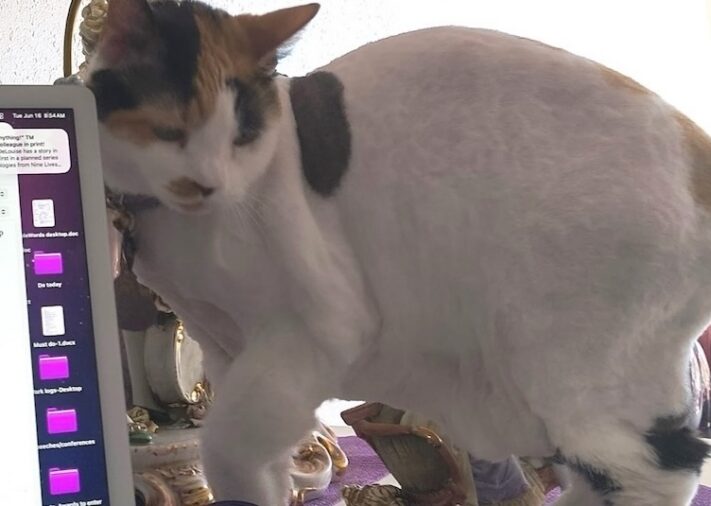
Be aware that the IRS will expect you to report every penny of your writing income, either in addition to money from a regular job or as your main income. Start with a separate bank account and credit card for your writing activity. That helps you organize and track writing-related expenses. If you record income and expenses as they occur, it makes tax preparation and filing time a lot less … taxing, and provides information about how your writing work is doing from a financial perspective. (If only I could deduct Skitter as my muse and editorial assistant …)
Open a savings account and deposit a percentage of every payment to build a fund for taxes and unexpected business expenses.
In charging for your work, here’s Karin Cather again: “… to figure out how much to charge, you need to convert how much money you need to make a living into an hourly rate …”
Writing is usually paid by the word, and the client/publication usually has a firm rate. Sometimes you can negotiate for a better one by calculating the time involved in a seemingly low-paying assignment, pointing out your experience or expertise as a bargaining chip, or agreeing to an initial rate as long as it will increase after successful assignments. It can help to think of smaller projects in hourly terms: $150 for 1,000 words isn’t much when weighed by the word, but not bad if the story only takes an hour or two (at most) to research and write.
Other Considerations
Being seen and found
If you don’t already have one, start a website — at least purchase a domain name for the one you will create, ideally something based on your writing genre. Purchasing/Registering is usually not even $20/year, and you have the name in place for when you’re ready to have an actual site. The hosting service costs more — from about $100 to as much as $350/year, depending on the company and the level of service or data you use. You also will want to set funds aside to have a professional web designer get you set up; they can stay with you to provide updates, or show you how to do your own maintenance and additions. Many people set up their own sites, but a professional designer can add a strong technical foundation that could be vital.
Importantly for your writing business, having a website domain means you can have a permanent email address (my domain name is https://www.writerruth.com; my eddress is Ruth@writerruth.com). With a domain-based address, you can change providers every other day if needed and never have to notify anyone about a change, because your email forwards from whatever provider (ISP) you use, such gmail.com, att.net, etc.
Your domain-based email address also helps promote you and your writing business, and makes you stand out as a professional.
Set up LinkedIn, Instagram, and other social media accounts so you can be seen and found by colleagues and potential clients. Try to post to these platforms regularly to establish yourself as an experienced, skilled, successful writer in your genre. You don’t have to be on every social media platform in existence; choose which one your audience is most likely to use where you can establish yourself as an experienced, skilled, successful writer in your genre.
Join at least one professional association about writing and one about freelancing, and make smart use of these communities to ask questions, offer advice, announce successes, etc. As with smart social media, active association involvement positions you as a successful professional whose writing is worth buying by clients or readers.
Consider starting a blog, with the caveat that making your writing accessible for free through a blog could cost you publishing opportunities — many traditional publishers won’t use work that’s already out there in a blog, and blogging makes it easy for someone to steal or plagiarize your words. However, a blog is a good way to display your writing voice, process, and successes, and some people have received book deals based on their blogs.
A social media presence is a good way to build a following for the moment when you might finish writing that book you’ve been thinking about or working on — whether you aim to publish traditionally or independently, you’ll need a following of people who might buy that book, and today’s publishers want to see that.
Keeping records
A key to writing success is to keep track of everything from assignments and deadlines to payments received (whether royalties from a book or income from freelance assignments), expenses, taxes paid, and whatever else might be part of your writing business. That’s the “business” part of the writing life. Again, it might not fit your mental image of yourself as a creative soul, but it’s essential to making the most of your writing efforts. A spreadsheet is a good way to manage those business details.
Set up a filing system that’s easy to use, for both paper and electronic records, especially receipts that you’ll want at hand for tax time.
Find an accountant or CPA to help with establishing a good recordkeeping system and to handle your first year or two of tax preparation and filing. Once you’ve done that a couple of times, you might feel confident about handling taxes yourself, and will have a strong foundation for doing so. (What you pay a tax advisor, by the way, is … tax-deductible!)
Learn what constitutes tax-deductible expenses from your advisor, professional associations, or research (the IRS website is useful for this). You might be surprised at all the things you can deduct from the income you earn from your writing to reduce your tax bite.
Find an attorney to help with drafting your own contract(s) and understanding ones that publishers or clients might ask you to sign. There are online resources for contract language, but a human being might be a stronger option. Try not to do any writing work without a contract or letter of agreement that spells out what you will do, for how many words, on what deadline, with what rights, for what amount, etc.
Remember to send invoices when you finish a paying writing assignment, such as for a magazine or other client. Very few clients will send payment without receiving an invoice from you; it isn’t like a paycheck.
Protecting your work
Especially in these increasingly invasive days of artificial intelligence (AI), it’s vital to understand and protect your rights to your work. Skim the U.S. Copyright Office page and include rights language in your contracts.
Protecting yourself
Scams aimed at writers are proliferating at every turn. Educate yourself about the ways that scammers are trying to take advantage of writers and our work. While being active in social media helps build your — and your book’s or other writing work’s — visibility and reputation, which leads to more readers, sales or clients, and projects, it also opens us up to more scams.
Have a template for contracts — not every business, publication, or publisher has a contract, so sometimes we need our own.
The bottom line for your writing business to have a bottom line is to think like a businessperson even when in the throes of creating!
Colleagues’ insights
What are your favorite sources of writing advice? What do you recommend to colleagues as reading material? What business tips of your own can you share?
Resources for writers
Business as a freelancer —
“Get Paid to Write Getting Started as a Freelance Writer,” by Ruth E. Thaler-Carter; from the author at Ruth@writerruth.com
“Freelancing 101: Launching Your Editorial Business,” by Ruth E. Thaler-Carter and Robin Martin, Editorial Freelancers Association, www.efa.org
“Resumés for Freelancers: Make Your Resumé an Effective Marketing Tool … and More,” by Sheila Buff and Ruth E. Thaler-Carter, Editorial Freelancers Association, www.efa.org
“On the Basics” columns, An American Editor blog, https://americaneditor.wordpress.com/
Writer’s Ally blog, https://thewritersally.com
Contracts —
“The Paper It’s Written On,” by Dick Margulis and Karin Cather
Writing —
On Writing Well, by William Zinsser
Bird by Bird, by Anne Lamott
On Writing: A Memoir of the Craft, by Stephen King
No Rules, Just Tools: Writing Tricks and Techniques for Crafting an Unputdownable Book by Julie Haase
Copyright —
U.S. Office of Copyright
Scams —
Writer Beware
“On the Basics” columns, An American Editor blog (https://americaneditor.wordpress.com/?s=Scams)
AARP
Organizations
Cat Writers’ Association, www.catwriters.com (and groups for people who write about dogs, birds, reptiles, horses, etc.)
National Writers Union, www.nwu.org
National Association of Independent Writers and Editors, www.naiwe.com
Editorial Freelancers Association, www.the-efa.org
Associations for writers in science, education, business, children’s/young adult, romance, and other genres
*Photos by Ruth E. Thaler-Carter. Do not reproduce without prior permission.

About the Author
Ruth E. Thaler-Carter (www.writerruth.com) is a longtime freelance writer/editor who shares her home with Skitter, “the world’s best cat.” She is chair of the CWA Blog and has been a CWA conference speaker, secretary, and blog poster.
Thanks Ruth! I have very little understanding of the business of writing, and appreciate the discussion.
I do some of it already, such as reporting to the IRS, and other things I’ve put off or ignored completely. (I’d rather be writing!) But this is a good list of advice I can follow.